Gender-Based Strategies and use of indigenous systems in Dairy Farming Households in Western Uganda
Wednesday, February 25, 2026 from 1:00 pm to 2:30 pm
- Virtual event
- Zoom meeting link
- Cost: free
- Contact
- Institute of African Studies, africanstudies@cunet.carleton.ca
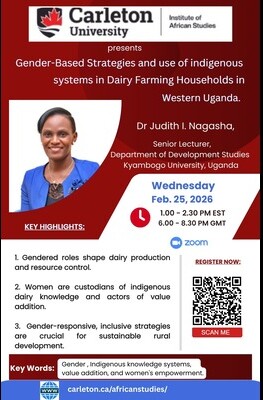
Join us for the Brownbag Seminar entitled “Gender-Based Strategies and use of indigenous systems in Dairy Farming Households in Western Uganda” by Dr. Judith I Nagasha, Senior Lecturer at Kyambogo University.
Join us for an engaging Brownbag Seminar exploring how gender dynamics and indigenous knowledge systems shape dairy farming households in Western Uganda.
Livestock production in Western Uganda is deeply embedded in socio-cultural norms and long-standing traditional practices. In this seminar, Dr. Judith I. Nagasha examines how gendered divisions of labour influence access to resources, decision-making authority, and control over dairy production. While men often dominate cattle ownership and milk sales, women are central to daily herd management, milk handling, processing, preservation, and household nutrition.
Drawing on research from dairy-farming communities, this presentation highlights how indigenous dairy management systems — including traditional herd practices, milk preservation techniques, sanitation methods, and value-addition processes such as ghee and fermented products — are largely sustained and transmitted by women. Despite their critical contributions, women often face barriers to participating fully in formal dairy markets, extension services, credit systems, and technological innovation.
The seminar will discuss:
- The intersection of gender norms and livestock economies
- The role of indigenous knowledge in dairy productivity and food security
- Structural constraints affecting women’s economic participation
- Gender-responsive strategies for sustainable and inclusive dairy value chains
By integrating indigenous systems with modern dairy innovations through inclusive policy and targeted interventions, sustainable dairy value chains can be strengthened, household resilience enhanced, and broader goals of gender equity and rural development advanced.
This session will be of interest to scholars and practitioners in gender studies, agricultural development, African studies, rural sustainability, food systems, and policy innovation.